|
|
Fake
Railroad Keys
With the ready availability of blank key stock and the
ease with which such stock can be marked, it is no surprise that keys
are among the most vulnerable artifacts for counterfeiting. Fake railroad
keys have been reported since the early days of the hobby, and the problem
is getting worse. Detecting them can be difficult and even controversial.
Veteran collectors have disagreed over the authenticity of a given key,
and there are no hard and fast rules that can distinguish the real thing
from the counterfeit in every instance.
Nevertheless, collectors can protect themselves by applying
the advice that is usually given with respect to all railroad collectibles:
(1) learn as much as you can, (2) buy from known and trusted sources
whenever possible, and (3) look at everything with a healthy dose of
suspicion. Counterfeit keys are often detected by the lack of a patina
-- what collectors sometimes call "pocket wear". Therefore
beware of keys that look unused, have a rough surface, or have crisp,
unworn initials. Also, be aware of the practice of grinding off common
(less valuable) railroad initials on keys and stamping rarer ones in
their place. This is particularly troublesome because the patina of the
old key adds to the deception.
Following is information on fake railroad keys....
 A collector recently (April, 2025) sent the following image as examples of a fake key. His comment was as follows: "This is trying to pass as a US Steel key but is clearly bogus. The U is absurdly tall and the letters seem cast in and not stamped. The barrel-bow connection is not smooth, plus the bit is not a sharp, distinct cut." Note that US Steel has historically had numerous railroads within their corporate domain, and still does. Click on the image for a larger version; use your BACK button to get back to this page. {Thanks to DK} A collector recently (April, 2025) sent the following image as examples of a fake key. His comment was as follows: "This is trying to pass as a US Steel key but is clearly bogus. The U is absurdly tall and the letters seem cast in and not stamped. The barrel-bow connection is not smooth, plus the bit is not a sharp, distinct cut." Note that US Steel has historically had numerous railroads within their corporate domain, and still does. Click on the image for a larger version; use your BACK button to get back to this page. {Thanks to DK}
Bill and Sue Knous, in their book
on counterfeit railroad collectibles list the following keys as
having been reproduced in great numbers:
| Railroad |
Manufacturer |
Serial # |
| ACL |
ADLAKE |
37813 |
| C&EI |
ADLAKE |
803 |
| D&E RR |
ADLAKE |
|
| FEC RY |
ADLAKE |
7029 |
| CG&SJ RR |
|
|
| GR&I |
ADLAKE |
2705 |
| NYO&W |
|
1320 |
| NCO RY |
FRAIM |
104 |
| QA&P RY |
A&W (HEX) |
|
| SA&AP RY |
|
|
| SEABOARD |
SLAYMAKER |
39247 |
| SNSY |
FRAIM |
104 |
Following are images of fakes or questionable keys that
illustrate some of the different types of counterfeits that a collector
may encounter. These images and accompanying information were generously
provided by Larry Wolfe and Bill Pollard.
 |
|
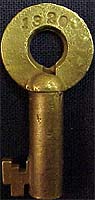
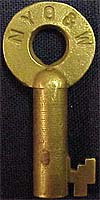
The infamous NYO&W #1320. Shown here are
front and back views of a fake key pretending to be from the New,
York, Ontario & Western Railway. Large numbers of these keys
with the serial number "1320" have been produced. Note
the lack of wear on this key, a tip-off that it might be a fake,
even if not well known.
Update. In early 2006,
a collector emailed us about a variation seen on an internet auction. It
is identical to the one in the photo except the serial number 1320 has
become 13208, and the word ADLAKE has been added on the side with the serial
number. |
|
|
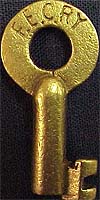
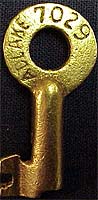
FEC RY #7029. In the same league
as the NYO&W key is this fake key marked for the Florida East
Coast Railway. Front and back views are shown. Large numbers of such
keys, marked "7029", have been made. Again, note the rather
uneven but crisp (unworn) lettering as well as the total lack of
wear on the hilt and barrel. |
|
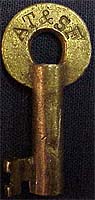
AT&SF. The key shown at left with the rather
crude lettering appears to be from 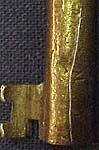 the
Atchison, Topeka & Santa Fe Railway. In addition to the uneven
lettering, this key has another odd quality: it's actually made of
lead! The collector who provided these images says that the key not
only looked odd but produced a dull sound when dropped on a hard
surface -- unlike a real key which produces a metallic ring. Upon
scratching the barrel (see image at right), he discovered that it
was made of a soft metal, probably lead. the
Atchison, Topeka & Santa Fe Railway. In addition to the uneven
lettering, this key has another odd quality: it's actually made of
lead! The collector who provided these images says that the key not
only looked odd but produced a dull sound when dropped on a hard
surface -- unlike a real key which produces a metallic ring. Upon
scratching the barrel (see image at right), he discovered that it
was made of a soft metal, probably lead. |
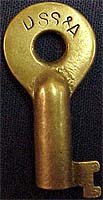 |
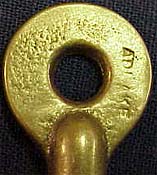 DSS&A. The
key shown at left looks like it was made for the Duluth, South Shore & Atlantic
Railroad. Someone who looked only at the lettering might be reassured
by the apparent wear - a quality collectors call "pocket worn." However,
the wear on the lettering is inconsistent with the rest of the key,
particularly the reverse side of the hilt (see close-up at right),
which looks new and unused. One likely explanation is that the "DSS&A" lettering
was applied after the original lettering had been ground off. This
is another trick of counterfeiters - substituting uncommon lettering
for the initials of a less collectible railroad (in this case, possibly
BN). The moral: make sure that a key shows the kind of even wear
that you would expect to see as a result of actual service. DSS&A. The
key shown at left looks like it was made for the Duluth, South Shore & Atlantic
Railroad. Someone who looked only at the lettering might be reassured
by the apparent wear - a quality collectors call "pocket worn." However,
the wear on the lettering is inconsistent with the rest of the key,
particularly the reverse side of the hilt (see close-up at right),
which looks new and unused. One likely explanation is that the "DSS&A" lettering
was applied after the original lettering had been ground off. This
is another trick of counterfeiters - substituting uncommon lettering
for the initials of a less collectible railroad (in this case, possibly
BN). The moral: make sure that a key shows the kind of even wear
that you would expect to see as a result of actual service.
|
|
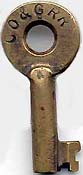 |
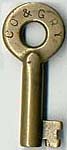
CO&G. In 2001-2002, a number of questionable or fake Choctaw,
Oklahoma & Gulf (CO&G) keys have appeared.. The Choctaw, Oklahoma & Gulf
was formed in the mid-1890s, and was acquired by the Rock Island in mid-1902.
It was operated as a subsidiary of the Rock Island until 1904, at which
time the company was assimilated into the Rock Island.
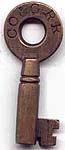 One
questionable CO&G key appears to be a remarking of a modern Adlake
key,shown upper right. The opposite side has the markings "A291" and "S".
The markings seems old, and the key is worn, but it appears to be a more
modern key than would be expected for the CO&G, given its history.
For comparison, the key at left appears to be legitimate. The tapered
barrel and more elaborate lettering suggest an earlier vintage key, consistent
with the operating period of the CO&G. One
questionable CO&G key appears to be a remarking of a modern Adlake
key,shown upper right. The opposite side has the markings "A291" and "S".
The markings seems old, and the key is worn, but it appears to be a more
modern key than would be expected for the CO&G, given its history.
For comparison, the key at left appears to be legitimate. The tapered
barrel and more elaborate lettering suggest an earlier vintage key, consistent
with the operating period of the CO&G.
The key at lower right is almost certainly a fake, with incorrect bit
design, crude marking, evidence of chemical aging, and insufficient wear
pattern.
Update: After this information was posted here, a veteran key
collector, Greg Whitaker, sent us the following information in April
2003: The C.O.&G. RY key numbered A291 on the reverse is quite genuine
and of the period. I have a key in this series numbered A693 I bought
from Scott Arden [a well-known railroad artifacts dealer] over twenty
years ago. At the same time I bought a cast C.O.&G. lock and key
from him --same series key -- which I was unhappy with and returned.
Both keys were A&W hex. I have many A&W hex and oval keys from
this period. This is not an "ADLAKE" design key. This style
key is A&W hex or oval--and NOT "ADLAKE"
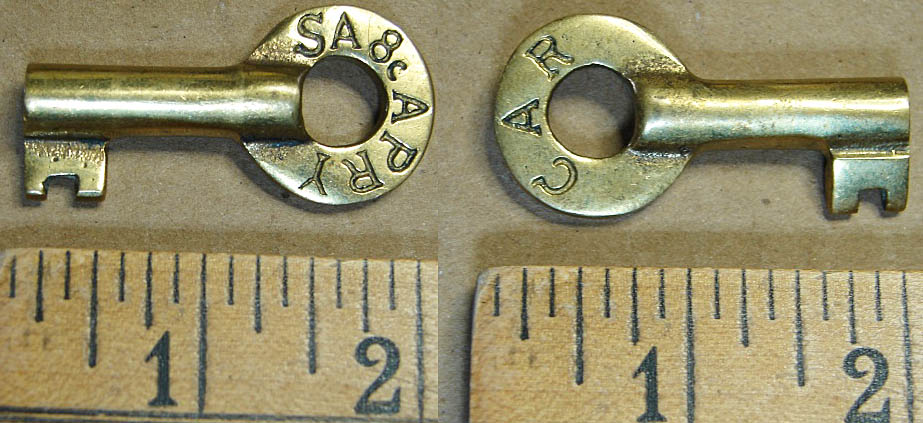
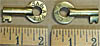 Update Spring 2019: We receved the following email: "The chart above has the initials 'SA&AP RY', but there is a blank for serial number – I understand this particular fake usually has the word CAR instead of numbers … The chart as is rather implies that any key from that line is a fake, but apparently they are not, only fakes with CAR on them – and of course there are authentic CAR ones as well. Here is a photo of a fake example. I am told these were made as decorator items and always are bright brass. Authentic keys almost certainly won't have that kind of 'look' or finish, let alone an '8'c instead of an '&' which is another dead giveaway on the fakes." Update Spring 2019: We receved the following email: "The chart above has the initials 'SA&AP RY', but there is a blank for serial number – I understand this particular fake usually has the word CAR instead of numbers … The chart as is rather implies that any key from that line is a fake, but apparently they are not, only fakes with CAR on them – and of course there are authentic CAR ones as well. Here is a photo of a fake example. I am told these were made as decorator items and always are bright brass. Authentic keys almost certainly won't have that kind of 'look' or finish, let alone an '8'c instead of an '&' which is another dead giveaway on the fakes."
See also Fake Conrail Keys and Fake New Old Stock Keys.
Special thanks to Bill and Sue Knous, Larry Wolfe, Bill
Pollard, Jane Silvernail and Greg Whitaker.
|